Why Professional Water Testing Matters More Than You Think
Water is one of those things we tend to trust without thinking too much about it. Turn on the tap, fill a glass, and move on with the day. But clear water isn’t necessarily clean water, and a strange taste or occasional odor isn’t always something you should simply get used to.
Water quality can change for many reasons. Groundwater may naturally contain minerals, older plumbing can introduce unwanted metals, and municipal or well water can carry different contaminants depending on local conditions. That’s why understanding what’s actually in your water is a smart first step before choosing a filtration or treatment system.
For homeowners, a little information can prevent a lot of guesswork. Instead of buying a system because a neighbor recommended it, you can make decisions based on the specific characteristics of your own water.
Start With Knowing What’s in Your Water
Every water supply is a little different. Two homes only a few streets apart can have noticeably different water quality, particularly when one relies on a private well and the other receives municipal water.
Common water concerns include hardness caused by calcium and magnesium, chlorine, sediment, iron, sulfur compounds and certain heavy metals. Some contaminants have obvious signs, such as staining, scale or an unpleasant smell. Others don’t announce themselves at all.
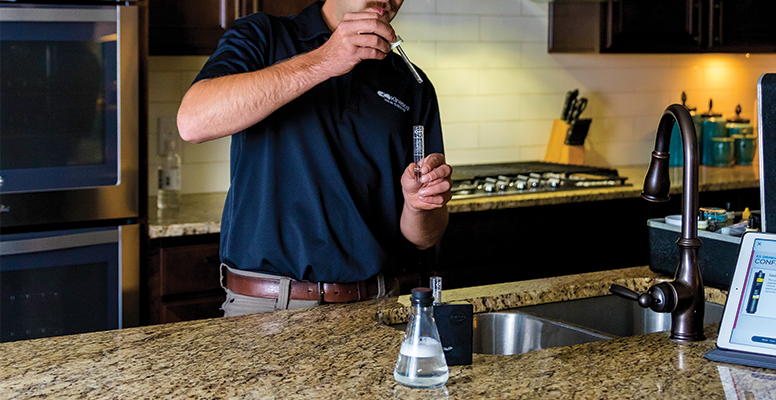
That’s where free water testing can be useful. A basic water analysis can identify several common issues and give homeowners a clearer picture of what their water actually needs. It also helps avoid the classic mistake of treating a problem that isn’t there—or overlooking one that is.
Testing isn’t about creating fear. It’s about replacing assumptions with information.
Hard Water Is More Than an Annoyance
Hard water is particularly common in many areas, and while it isn’t usually a reason to panic, it can become a real household nuisance.
Calcium and magnesium in hard water can leave white deposits around faucets, showerheads and appliances. Soap may struggle to lather properly, dishes can come out looking cloudy, and bathrooms often require more scrubbing than anyone would like.
Over time, mineral scale can also build up inside water heaters and plumbing fixtures. That buildup may reduce efficiency and contribute to maintenance problems.
A water softener can help in situations where hardness is the primary concern. But choosing the right system depends on the hardness level, household water usage and other characteristics of the supply. Again, testing comes before guessing.
Why Professional Guidance Makes a Difference
There’s no shortage of water treatment products available today. You can find compact filters, whole-home systems, softeners and drinking-water solutions in a wide range of prices. The challenge isn’t finding a product. It’s figuring out which one actually makes sense for your home.
This is where licensed technicians can bring valuable experience to the conversation. A qualified professional can evaluate your plumbing setup, review water test results and explain which treatment options are appropriate.
That matters because water treatment isn’t one-size-fits-all. A carbon filter may be useful for chlorine and certain taste or odor concerns, while a softener addresses hardness. Reverse osmosis can provide highly treated drinking water at a specific point of use, while whole-home filtration is designed to address water entering the house.
A good technician should explain those differences in plain language—not overwhelm you with technical jargon or push the most expensive equipment.
Choosing the Right Water Treatment System
Once you understand your water quality, the next step is matching the treatment technology to the problem.
For example, households dealing mainly with hard water may benefit from a water softening system. If chlorine affects taste or odor, activated carbon filtration may be a better fit. Sediment filtration can help with visible particles, while specialized systems may be needed for specific contaminants.
Some homes need more than one stage of treatment. A well-water household, for instance, may have hardness along with iron, sulfur odor or sediment. In that situation, combining technologies can make more sense than expecting one filter to handle everything.
The important thing is to treat the water based on evidence rather than marketing claims.
Why the Dealer You Choose Matters
Even an excellent water treatment system won’t perform properly if it’s poorly selected, incorrectly installed or neglected after installation. That’s why the company behind the equipment matters almost as much as the equipment itself.
Working with an authorized kinetico dealer can give homeowners access to product expertise, installation support and ongoing service for Kinetico water treatment equipment. An authorized dealer can also help determine which system is appropriate for the home’s specific water conditions instead of treating every installation like an identical project.
That relationship can be especially helpful when your system eventually needs maintenance, adjustments or replacement components. Having someone familiar with the installation saves time and, frankly, plenty of frustration.
Don’t Ignore Changes in Your Water
Sometimes homeowners notice a sudden change in taste, color, pressure or odor and assume it will disappear. Sometimes it does. Sometimes it points to something worth investigating.
A rotten-egg smell, for example, may be associated with hydrogen sulfide in some water supplies. Brown or orange staining can be linked to iron. A sudden metallic taste could have several possible causes, including plumbing-related issues.
The point isn’t to diagnose a problem from a smell or stain alone. Water can be surprisingly complicated. Testing and professional evaluation are much more reliable than trying to play detective with a glass of tap water.
It’s also worth remembering that water quality can change over time. Wells can be affected by environmental conditions, plumbing systems age, and local water sources can change. Periodic testing is a sensible habit, especially when there are noticeable changes.
Better Water Starts With Better Information
There’s something reassuring about knowing exactly what you’re dealing with. Instead of wondering whether your water is too hard, whether that odd taste is normal, or whether your appliances are suffering from mineral buildup, you can get answers and act accordingly.
Professional water testing, proper equipment selection and skilled installation all work together. None of them needs to be complicated for the homeowner. In fact, the best water treatment experience is usually the one that feels surprisingly straightforward.
Clean, pleasant water shouldn’t require constant second-guessing. Start with the water itself, understand the problem, and then choose a solution designed around your home. That simple approach can protect plumbing, improve everyday water quality and make one less household worry worth carrying around.